Sleep can feel fine right up until mornings start dragging, focus gets fuzzy, and caffeine turns into a coping strategy. An AI Sleep Quality Test tries to put numbers on that drift by turning nightly signals into repeatable metrics and a simple “good vs. needs work” snapshot.
Wearables and apps can’t replace a lab diagnosis, yet the trend data often helps spot patterns that people miss day to day. That matters because sleep problems rarely show up as one dramatic bad night; they show up as a slow slide.

What An AI Sleep Quality Test Really Measures
Most tools boil the night down into a dashboard: duration, sleep stages, interruptions, and a daily readiness-style summary.
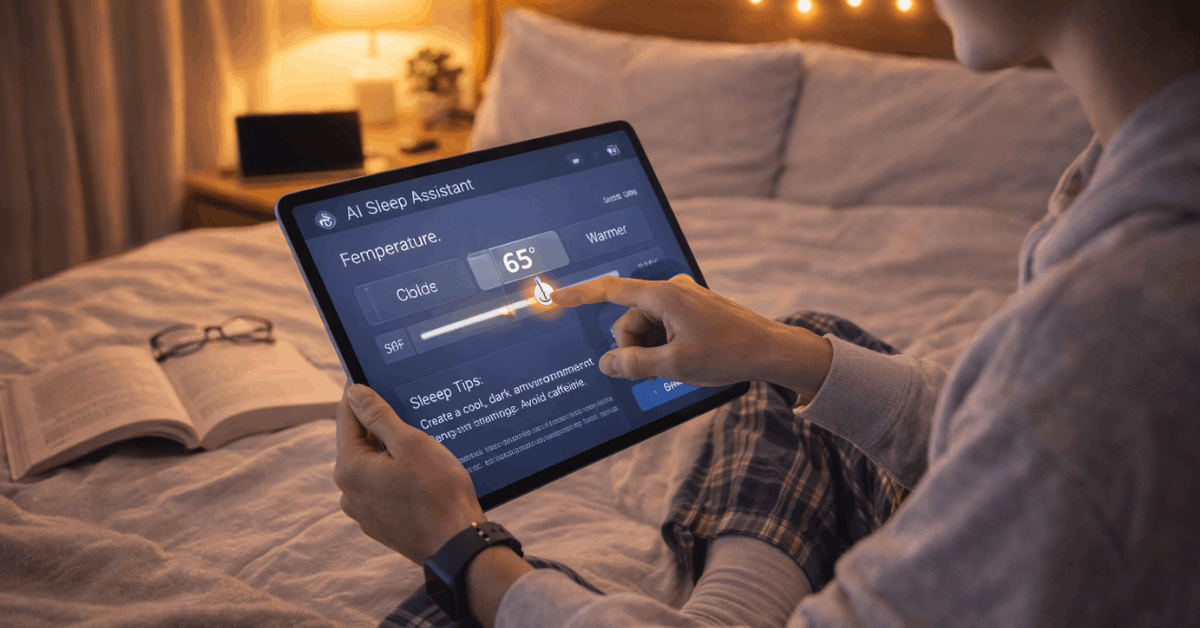
The helpful part usually sits under the score, not inside it. The score changes because one or two levers changed, such as late caffeine, a heavy workout, a hot bedroom, or stress that spikes overnight heart rate.
A solid AI approach also captures variation across the week. One perfect night followed by three rough ones still leads to daytime fatigue, even if the weekly average looks “okay.” Trend views show that mismatch clearly.
How AI Sleep Trackers Work
Smart rings, watches, and mattress sensors all start the same way: signals get collected, cleaned, and then interpreted by models trained on large sleep datasets.
Accuracy depends on sensor quality, how well the model generalizes, and how closely the environment matches the data used for training.
Data Signals Collected Overnight
Most wearables track motion and pulse data, then estimate sleep state changes across the night.
Heart rate variability is commonly used as a recovery proxy, since it reflects shifts in autonomic nervous system balance during rest. Some tools add breathing features through audio or optical sensing, then flag snoring intensity and breathing disruption patterns.
Mattress sensors often lean harder on movement and respiration-like signals, while wearables lean on pulse, movement, and temperature trends. Each design comes with tradeoffs.
How Sleep Stages Get Predicted
Many consumer systems rely on classic machine learning approaches, then modernize the pipeline with deeper neural methods. Older stage classifiers often reference models such as Support Vector Machines, K-Nearest Neighbors, and Random Forest.
Newer systems increasingly learn features directly from the raw signals, cutting down on hand-crafted rules. Large research efforts are moving toward “whole-night” modeling rather than scoring only tiny slices.
Mount Sinai researchers reported a transformer-based model called PFTSleep in March 2025, trained on over a million hours of sleep study recordings and designed to interpret an entire night more consistently than conventional short-segment scoring.
What The Results Usually Look Like
Most apps show stage estimates, nightly disruptions, and a score anchored to a few core measures. Sleep efficiency often gets emphasized because it links “time in bed” to “time actually asleep,” and the gap between those two numbers explains a lot of frustration.
Sleep latency appears as the time it takes to fall asleep, and repeated awakenings raise the “restless” feel, even when total hours look decent.
Accuracy and Limits: Useful, Yet Not A Lab
A clinical polysomnography study remains the gold standard for diagnosing disorders because it measures brain waves, muscle tone, breathing, oxygen, and more under controlled conditions. Consumer AI tries to approximate that picture through fewer sensors and indirect signals.
Some wearables perform surprisingly well on broad sleep vs. wake classification, and several peer-reviewed validations show decent agreement on global sleep measures.
Oura Ring validation research in 2024 reported strong performance on overall sleep metrics and respectable stage results, though stage-by-stage performance still varies across light, deep, REM, and wake. Deep sleep estimation often remains the hardest area for many consumer devices, since deep-stage boundaries can be subtle without EEG.
Sleep Apnea Detection
Sleep apnea detection is a promising area, yet caution belongs front and center. A 2024 systematic review and meta-analysis on wearable AI reported a pooled accuracy of around 0.89 in the included estimates, while also stressing inconsistent methods and performance gaps that limit routine clinical use.
Real value often comes from flagging risk signals that justify a proper clinical evaluation, not from “confirming” apnea at home.
What Good Sleep Quality Looks Like On Metrics
Good sleep isn’t only about hours. Rested mornings usually happen when continuity, timing, and recovery signals line up for several nights in a row.
National Sleep Foundation checklists and sleep medicine guidance tend to converge on a few practical targets, and most AI dashboards map cleanly onto them.
- Sleep latency at 30 minutes or less on most nights.
- Wake after sleep onset kept low, since extended awake time after falling asleep often explains groggy mornings.
- Sleep efficiency at 85% or higher, meaning most time in bed is actually spent sleeping.
- One wake-up or fewer on a typical night, though age and context matter.
- Morning restoration that feels real, not forced, across several days.
A sleep score can help frame those targets. Many platforms use a 0–100 scale where 90–100 reads as excellent, 80–89 good, 60–79 fair, and below 60 poor, though each brand weights components differently.
A Quick AI Sleep Quality Test Quiz
A quiz can’t diagnose a disorder, yet it can clarify whether the pattern looks like mild lifestyle drift or something worth medical attention. The questions below mirror what many clinicians ask first, and they align with the same signals tracked by most wearables.
Sleep specialist Dr. Deepa Burman, MD, FAASM, puts the value plainly:
“Sleep can help restore immune function, improve athletic performance, and help regulate body metabolism.”
- Falling asleep usually takes longer than 30 minutes, three or more nights per week.
- Nighttime awakenings happen more than once most nights, or returning to sleep often feels difficult.
- Daytime sleepiness shows up at least three days per week, even after a “full” night.
- Snoring, choking, or gasping has been noticed, or the app repeatedly flags breathing disruption risk.
- Mood, focus, or reaction time has clearly worsened over the past month.
“Mostly no” points toward routine optimization and consistency. Mixed answers suggest tracking trends for two to three weeks, then adjusting one lever at a time. Several “yes” answers, especially the breathing item, point toward professional screening rather than more self-experimenting.
Next Steps That Actually Improve The Numbers
Consistency beats complexity for most people. A stronger result comes from tightening the inputs that AI models react to, then checking whether the changes move the right metrics in the right direction.
NO Device Close to Bedtime
Keep electronics out of the sleep space when possible, and stop scrolling close to bedtime.
Light exposure and mental stimulation tend to delay sleep onset, which raises sleep latency and lowers next-day recovery signals. Caffeine timing also matters more than most people expect; late-day caffeine can keep heart rate elevated overnight even when sleep feels “fine.”
Room Awareness
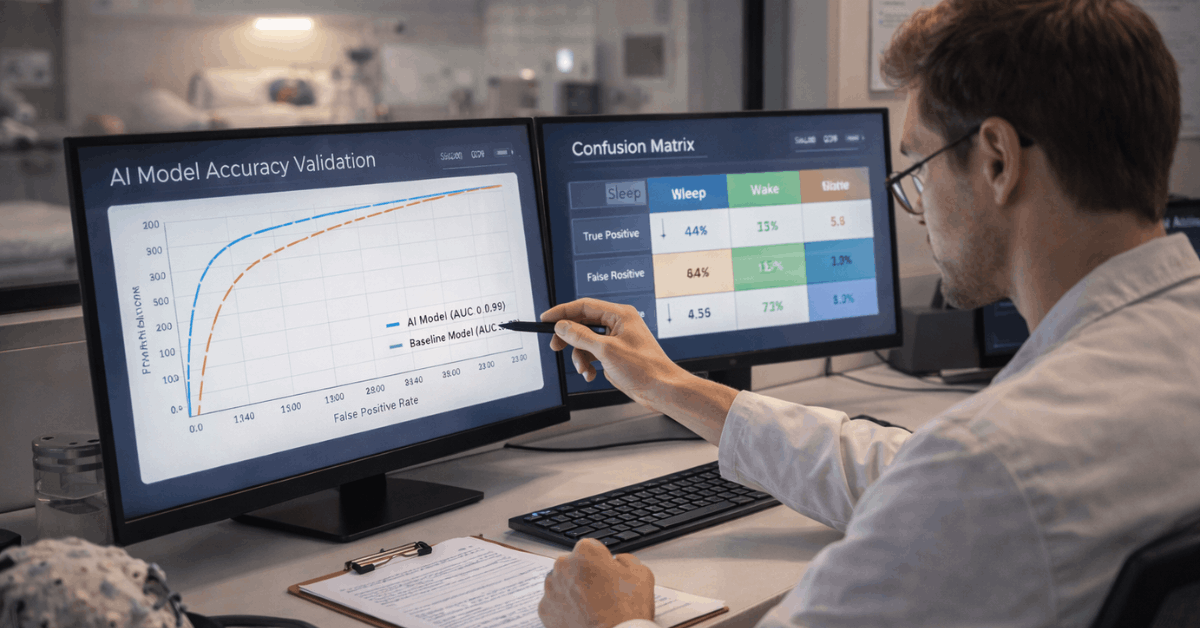
A cooler, darker room often lowers awakenings and improves continuity. Exercise helps many sleepers, yet heavy late-night training can push sleep onset later for some, so timing experiments should be simple: change one variable for a week and watch the trend.
Health Awareness
Medical attention matters when red flags keep showing up. Loud snoring, witnessed breathing pauses, repeated choking or gasping, persistent insomnia symptoms, and unrelenting daytime sleepiness are all reasons to speak with a clinician.
AI can support the conversation by showing pattern timing and frequency, yet diagnosis and treatment decisions belong with qualified professionals.
Last Thoughts
Sleep data gets useful once it changes decisions, not because the score looks impressive on a chart.
An AI Sleep Quality Test works best as a pattern detector that helps connect inputs like caffeine timing, heat, stress, and late screens to outputs like latency, awakenings, and next-day fog.
Scores and stage charts still have limits without EEG and clinical sensors, so the safest mindset is “track, adjust, verify,” especially when breathing flags or daytime sleepiness keep repeating. Real progress usually comes from boring consistency across two to three weeks, then handing off to a clinician fast when the signals look like more than lifestyle drift.