Optimize sleep and brain performance using AI when tracking turns into decisions, not dashboards. AI systems already move past “hours slept” and start connecting sleep stages, temperature, light exposure, and stress signals into a practical plan.
Consumer tools still vary in accuracy, yet the direction is clear: better inputs, better predictions, better daily energy. Stronger sleep tends to show up as steadier focus, calmer mood, and fewer “why am I fried at 2 p.m.” moments.


What AI Changes About Sleep and Brain Performance
AI makes sleep improvement more actionable because patterns become visible faster. A wearable can spot repeated late-night heart rate elevation, a noisy room, or a too-warm mattress, then link that to lighter sleep and morning fog.
That’s the shift: passive graphs turn into interventions that are personalized, timed, and sometimes automated.
What AI Tracks and Monitor
AI sleep tracking usually starts with stage estimates (deep, REM, light), plus heart rate, heart rate variability (HRV), breathing, movement, and skin temperature.
Clinical sleep staging still relies on polysomnography, yet consumer devices can still be useful when the goal is trend detection rather than medical diagnosis.
One week of consistent data often reveals more than a single “perfect” night, especially when travel, stress, alcohol, late workouts, or heavy meals change physiology.
AI Prediction
Predictive models are becoming part of this story too. Stanford researchers reported an AI sleep foundation model, SleepFM, that predicted 130 conditions from one night of sleep study data, using multimodal signals such as brain activity and breathing patterns.
That’s not a consumer feature today for most people, yet it shows how information-rich sleep signals can be when captured well.
Build An AI Sleep Baseline That Actually Helps
A baseline needs boring consistency. Data quality matters more than extra features, since “garbage in, garbage out” applies hard in sleep tech. Device swapping, irregular bedtimes, and inconsistent wear reduce signal quality and make recommendations feel random.
Start with two simple goals:
- stabilize sleep timing and
- stabilize wake timing.
Bedtime can vary a bit, yet wake time anchors circadian timing more reliably for most people. Circadian rhythm optimization gets easier once the model sees repeated patterns across weekdays and weekends, since the algorithm can separate “normal” from “one-off chaos.”
Wearable choice matters less than correct setup. Tight but comfortable fit, nightly wear, correct profile settings, and accurate logging for alcohol, late caffeine, illness, and unusually hard training give AI systems context they cannot infer reliably.
That context prevents dumb recommendations, like pushing earlier bedtime during a jet-lag week when light timing is the real issue.
Use AI To Engineer A Sleep-Friendly Environment
Environmental control is where AI earns its keep because the room can be adjusted even when willpower collapses. Heat spikes, bright screens, and noisy spaces disrupt sleep continuity, especially during the first half of the night when deep sleep should dominate.
Smart mattress temperature control is a high-leverage option for hot sleepers and people waking up sweaty. Eight Sleep’s Pod and Autopilot features describe automatic temperature adjustments based on sleep phases, schedule, comfort preferences, and environmental conditions.
Cooling and warming changes can reduce wake-ups that fragment sleep, which often matters more than pushing total sleep time. Practical automation options that tend to work:
- Smart lights dim to warm tones 45 minutes before bed, then shut off at bedtime.
- Thermostat targets a cooler setpoint for the first half of the night.
- Phone focus mode activates automatically, silencing notifications and restricting distracting apps.
- White noise or fan automation starts at bedtime and stops at wake time.
- Air purifier runs during sleep if allergies or air quality are an issue.
Blue light reduction still matters, though the science is nuanced.
Harvard Health summarizes evidence that blue light at night can suppress melatonin and shift circadian timing more than some other wavelengths. Digital hygiene becomes a system, not a pep talk, once routines run automatically.
Protect Daytime Brain Performance Using AI Signals
Sleep sets the ceiling for cognitive performance, yet daytime choices decide how close that ceiling gets reached. AI can help because mental energy is not a constant resource across the day, even when motivation feels high.
Cognitive Load Monitoring
Cognitive load monitoring is the practical lens here. Tools that infer stress and workload through calendar density, screen time, task switching, HRV, and self-reports can flag cognitive debt before it becomes a crash.
McKinsey and the World Economic Forum have framed this broader idea as “brain capital,” tying brain health and brain skills to productivity and resilience at a societal level. Their reporting highlights the scale of potential gains tied to scaling brain health interventions.
AI Productivity Tools
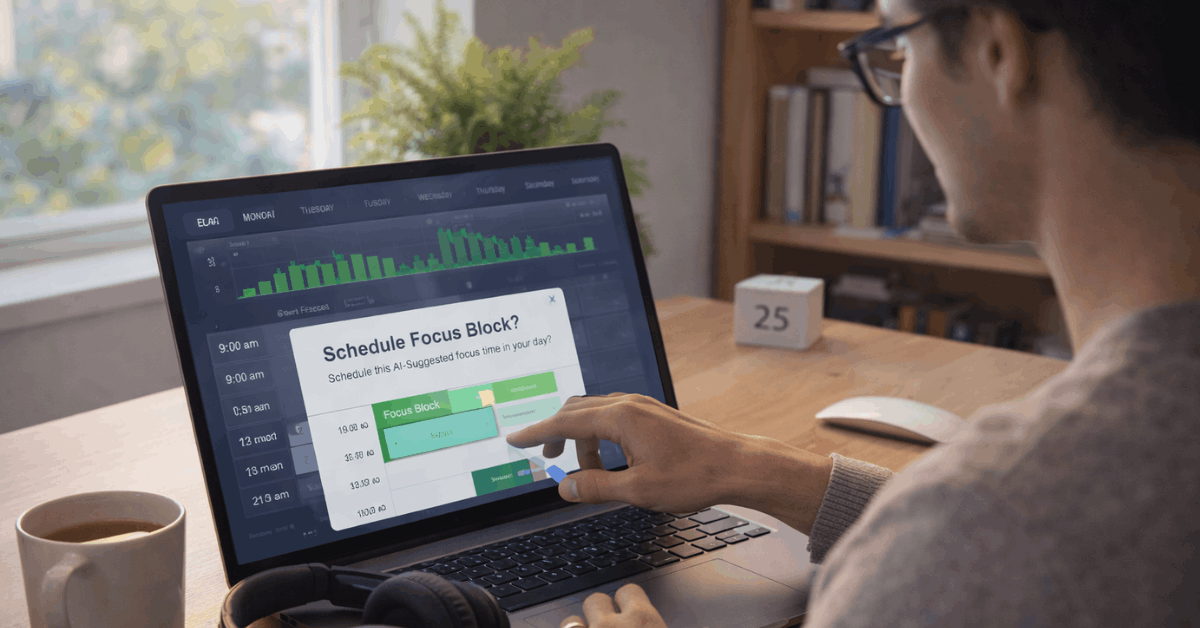
AI productivity tools help most when the goal is reducing decision fatigue. Drafting, summarizing, outlining, and turning notes into structured next steps can preserve mental bandwidth for judgment-heavy work. That benefit compounds when paired with time-blocking and planned recovery breaks.
Neurotechnology
Neurotechnology adds another layer for some people. An EEG sleep headband can measure brain signals more directly than movement-based wearables, though comfort and consistency become the trade-off.
Elemind describes EEG-based measurement paired with tailored acoustic stimulation to help sleep onset, and MIT News describes how the device measures brainwaves and generates audio dynamically through bone conduction.
Pink noise stimulation also shows up in this category, aiming to support smoother transitions into sleep for certain users.
Mental Health Guardrails and Ethical Use
AI can support mental well-being, yet boundaries matter because psychological data is sensitive and models can be wrong. Mental health tools also raise issues around privacy, bias, and over-reliance, themes that appear repeatedly in peer-reviewed reviews of AI in mental healthcare.
A few guardrails reduce risk without killing the benefits:
- Data privacy for wearables should be treated like financial security: review permissions, limit sharing, and use strong account protection.
- Medical symptoms require professional care, especially for insomnia, sleep apnea signs, panic symptoms, depression, or suicidal thoughts.
- “Advice” from apps stays advisory, not diagnostic, unless the product is clinically validated and used under clinician oversight.
- Bias checks matter for mental health screening tools, since training data can underrepresent certain populations.
Over-reliance is a quieter issue. Constant scoring can increase sleep anxiety, turning bedtime into a performance test. A weekly review cadence often works better than daily obsession, since trends matter more than single-night noise.
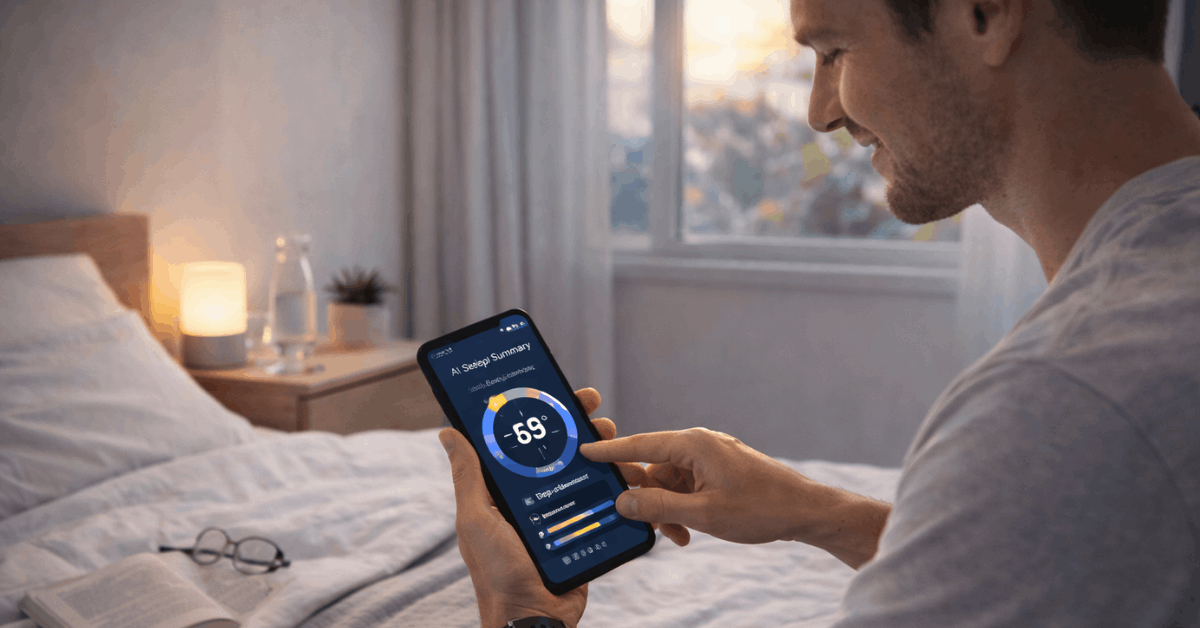
Troubleshoot and Iterate Like A System
A sleep plan should evolve across seasons, stress cycles, travel, and workload changes. AI makes iteration faster, yet only if experiments stay simple enough to interpret.
Run one change at a time for seven to ten nights, then compare trends. Room-temperature change, earlier caffeine cutoff, and new supplements create noise, not clarity. Focus on what moves the needle: fewer wake-ups, steadier wake time, higher morning energy, less afternoon fog, and fewer nights of long sleep onset.
A practical stack looks like this:
| Goal | AI Tool Type | Examples | Setup Focus | Best Signal To Watch |
| Sleep trends | Ring or smartwatch | Oura Ring, Apple Watch | Consistent nightly wear | Sleep timing consistency |
| Heat and wake-ups | Smart bed climate | Eight Sleep Pod | Auto schedule + phase tuning | Night awakenings |
| Faster sleep onset | EEG-based option | Elemind | Comfort + consistent use | Sleep onset time |
| Coaching and routines | Sleep apps | Sleep Cycle, SleepScore | Alarm and habit prompts | Wake quality notes |
| Integrated insights | Health platforms | Apple Health, Google Fit | Data permissions review | Week-to-week trends |
Accuracy also needs realistic expectations. Wearables can misclassify stages, especially REM versus light sleep, and motionless wake can look like sleep. Trend direction remains valuable even with imperfect staging, so long as the same device and routine stay consistent.
AI Tool Stack aAI can sharpen sleep and brain performance when signals turn into a small set of repeatable actions. Better outcomes come from consistency: stable wake time, clean inputs, and one change at a time, long enough to measure. Environmental automation often delivers the fastest wins because it reduces wake-ups without relying on willpower.
Guardrails still matter, since sleep data is sensitive and consumer insights stay non-diagnostic. Stronger sleep shows up in the simple places: steadier focus, calmer mood, and fewer energy crashes that derail the afternoon.nd A Simple Setup Checklist
Last Thoughts
AI can sharpen sleep and brain performance when signals turn into a small set of repeatable actions. Better outcomes come from consistency: stable wake time, clean inputs, and one change at a time, long enough to measure.
Environmental automation often delivers the fastest wins because it reduces wake-ups without relying on willpower.
Guardrails still matter, since sleep data is sensitive and consumer insights stay non-diagnostic. Stronger sleep shows up in the simple places: steadier focus, calmer mood, and fewer energy crashes that derail the afternoon.